
Contents
Orthodontics
Orthodontics
Orthodontic treatment is a series of procedures that move poorly aligned teeth into a better position. Malocclusions and crowding may occur with skeletal disorders of the teeth and jaws.

What is orthodontic treatment?
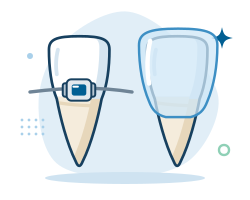
Crowded teeth are corrected with small square attachments called braces. Two main types of braces are used: metal (stainless steel) and ceramic (clear porcelain). These are bonded to the front surfaces of the teeth.
Who is it for?
Orthodontic treatment is used for malaligned and crowded teeth and for jaw development problems, in children and adults.
Orthopaedic treatment in children
When orthodontic problems come with skeletal problems, extraoral devices attached to the jaw and the back of the neck may be used. These devices guide the growing skeleton and aim to prevent surgical intervention in adulthood. They are generally worn about 18 hours a day.
How does the process work?
Metal braces
Widely used in orthodontics, with stainless steel and nickel-titanium wires.
Ceramic braces
Known as clear braces. They are preferred especially by adult patients with aesthetic concerns. Oral hygiene is even more important with ceramic braces.
Lingual orthodontics
The braces are bonded to the inner (tongue-side) surfaces of the teeth and prepared individually for each patient, so they are not visible from the outside.
Clear aligners
A series of transparent aligners planned on the computer gradually corrects the position of the teeth. See the clear aligners page for details.
Orthognathic surgery
If skeletal problems such as a forward, backward or sideways position of the upper or lower jaw are diagnosed before growth ends, they can be corrected with orthodontic treatment (maxillofacial orthopaedics). In adults, they are corrected with orthognathic surgery: the teeth are first aligned with braces, then the jaws are brought into the right position by surgery. The orthodontist plans this together with the surgeon. Surgery follows about 12-18 months of brace treatment and is performed in a fully equipped hospital; patients are usually discharged 1-3 days later. Orthodontic treatment continues after surgery, and braces are removed about 6 months later.
Removable appliances
Some simple tooth movements can be made with removable appliances worn for set periods. They are easy to make and use, but cannot make very precise movements.
How many sessions?
The length of treatment and the number of visits depend on the problem and the method chosen, and are planned at the orthodontic examination.
Last updated: Editor: Dent4 Levent Ağız ve Diş Sağlığı, dent4levent@gmail.com